
Those of us in the helping professions often provide services to clients (patients, coachees, etc.) when they’re stuck during life or business decisions, need different perspectives for decision making or to stop harmful habits. We ‘actively listen’ and pose questions to assess their situation, understand their goals, and guide them to what seems like their own answers.
But what if our exchanges contain biases that prevent them from finding their best solutions? Or unwittingly lead clients to flawed conclusions or personal risk? What if
- we can’t understand each other due to the way brains process incoming words?
- our questions are biased by our own assumptions and can’t get accurate information?
- we’re seeking information from a client’s mind and their change capability is in their brain?
- it’s not possible to change behaviors by trying to change behaviors?
- we don’t need to gather information or assess a client’s needs/problems to lead them to their own best answers?
What if there’s a more direct, unbiased, and precise route to helping clients discover and accomplish their ideal solution that avoids these pitfalls?
What if clients (and patients, and buyers, etc.) only need help finding where their answers/solutions are already stored in their unconscious and your intervention could lead them to it?
For those of you who like new ideas and don’t mind a bit of complexity, who work with consulting, OD, and counseling models that use verbal interactions as part of their process, I’ve written a Thought Paper to introduce a new way to think about change and discovery. Note: for Helpers working with non-conscious states, body-centered therapy, or mindfulness models that don’t use questions, I suggest the information on how brains listen, decide, and enable change will be helpful. If you’re interested in a more detailed discussion, email me at sharondrew@sharondrewmorgen.com.
OVERVIEW
We each make sense of the world and our lives through our unique mental models (beliefs, values, norms, assumptions, history) which form the basis of our decisions and life choices, restricting what we do, notice, think and hear.
As Helpers we’re especially affected: due to the way brains
- store and process our history and values-based criteria,
- form the choices that govern our lives,
- determine what we think was said,
there’s a high probability our natural biases and unconscious subjectivity will unwittingly get in the way of us accurately hearing each other, or noticing the client’s historic triggers to be considered.
WHAT THIS PAPER WILL DO
For times it’s important to hear and be heard without bias, there’s a direct route to change and decision making: lead clients to the unconscious choices where their current problems have been triggered and generate new ones for new outcomes. In other words, instead of understanding or assessing their problems, change your ultimate focus and merely lead them to their unconscious triggers for change.
At this point, it might be important for you to know who I am as my concepts don’t fit standard models. I’m an original thinker and have Asperger’s Syndrome. Like most folks ‘on the Spectrum’, I naturally think in systems – interconnected elements in the Status Quo that have agreed to the same rules, and work hard to maintain balance (Systems Congruence).
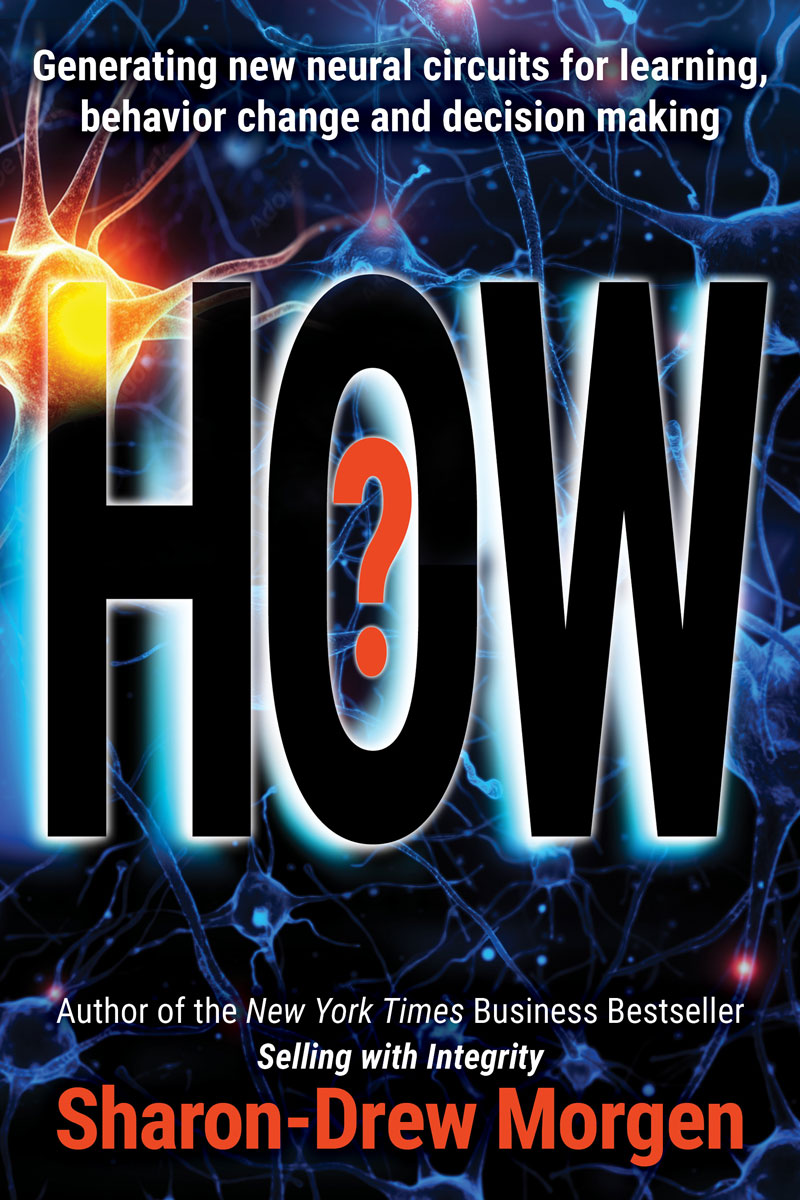
My lifelong topic has been discovering the elements involved in getting to the unconscious for conscious choice, and developing tools and models (Learning Facilitation, Buying Facilitation®, Change Facilitation, Facilitative Questions™) that enable permanent change at the source. I’ve successfully taught these globally to 100,000 sellers, leaders, coaches, and healthcare practitioners for over 40 years, and written a book on generating new circuits for behavior change a decision making (HOW?).
In this Paper, I’ll explain why current helping models (coaching, consulting, leadership, healthcare, etc.) often fail to produce permanent change and introduce an approach that’s more direct and long lasting. For those of you interested in learning any of the models, please contact me as it’s impossible to delve deeply into specifics in this paper. sharondrew@sharondrewmorgen.com.
Let me start by defining what I mean by change.
CHANGE
Most of us have our own definitions of change. Mine comes from my work with systems and neural connections:
- Change represents a modification to a unique system that holds existing choices in place.
- Any proposed change must maintain the core identity and beliefs of the larger system (the Status Quo) to maintain balance and Systems Congruence.
- Be it behavior-based or interior feelings, change emerges from the unconscious, physiologic, chemical, automatic, and meaningless neural activity that trigger our choices into conscious actions.
Currently, Helping professionals are taught to enable behavior change but fail to include and get buy-in from the client’s often-unconscious system that produced the offending behaviors to begin with. Note:
until or unless all the elements that created and maintained the presenting problem, and those that will be affected by the new choices, agree to do something different, the system will feel at risk and will resist any change regardless of the problem.
Permanent, congruent change requires:
- identification, assessment and agreement of the problem by the systemic, underlying elements that hold the Status Quo in place;
- buy-in from the system – the new must match the core beliefs, values, and norms (Systems Congruence) that represent the Status Quo;
- risk management – the system must understand, and consider solutions, for any potential risks before any changes occur.
Indeed, all change is systemic and must
- Maintain Functional Stability. Any change initiative must maintain the foundational balance of the original system. Change is not so simple as replacing one behavior with another.
- Achieve Buy-In. For a system to be willing to change successfully and avoid resistance, a system must
- understand and the risk of change;
- recognize exactly what fallout will occur when anything is added;
- know how each affected element must modify to maintain the integrity of the system.
- Maintain Underlying Rules and Beliefs. Great data or solutions, important needs or dangerous consequences do not influence change if they run counter to the system’s beliefs and rules, overt or covert.
- Avoid Risk. Risk can only be recognized by all who touch the status quo/system. Then it must be determined the magnitude of the risk. If it is seen to be less than any proposed change, it will be accepted. If the risk is greater than the proposed change, it will be resisted.
Here’s a rule I consider sacrosanct:
regardless of how extensive the problem or necessary the change, permanent change cannot occur if the system believes it’s at risk and may face major disruption.
There’s a way to get directly to the neural circuits that triggered the offending choices to enable permanent change. But first, let me explain why our current models are problematic.
YOU CAN’T CHANGE A BEHAVIOR BY TRYING TO CHANGE A BEHAVIOR
Unfortunately, today’s standard practices for change management as well as standard Behavior Modification practices ignore the brain change element and focus on attempting to modify the habits, the behaviors, decisions, actions etc. AFTER they’ve been generated. But by then it’s too late.
So what’s a behavior? Behaviors are merely outputs, expressions of our values and beliefs that announce to others who we are and what we stand for. They reside in neural circuits in our brain that trigger them when instructed to do so.
Every behavior is a symbol of who we are – a representation of our personal system. Every behavior is a belief in action, a statement of our values and beliefs, and a representation of our internal unconscious system.
Any proposed alteration to a behavior (or habit, or choice, or…) potentially represents a risk to the current system. When we attempt to make a change without modifying the neural circuits that triggered the problem, our lazy, habituated brain resists, preferring the originating pathways that maintain Systems Congruence. After all, it’s been working ‘fine’ for some time and habituated into daily norms and routines.
Sadly, behaviors can’t simply change themselves because we want to make a change. After all, our personal system must remain balanced (Systems Congruence). Therefore, permanent change must incorporate the underlying system of beliefs, norms, history, culture, and assumptions that form of the foundation of the offending actions.
When we merely try to change offending behaviors and overlook changing the origination points that triggered them we unwittingly cause imbalance, which results in resistance and non-compliance (the downside of current change models) as the system attempts to return to its normalized routines.
Indeed, it’s not possible to change a behavior by trying to change a behavior. This is the reason behavior-change models often fail to cause permanent change: permanent change requires reprogramming a new input message into the client’s unconscious. Once the new input (new message, new instructions) is accepted, it will automatically trigger a new output. Trying to change a behavior once it’s already an output is akin to putting toothpaste back in the tube.
BRAINS – WHERE SYSTEMIC, CONGRUENT ANSWERS COME FROM
Since I refer so often to neural circuits, let me simplistically explain the role the brain plays.
All our actions, what we see, hear, think and do, what we’re curious about and what we notice, our history and our values, originate in the unconscious as part of what makes us each unique: meaningless, automatic electrochemical signals brain, making connections between our 100 trillion neural circuits that each hold unique values-based criteria (beliefs, norms, history, etc.) that form and trigger our choices.
When the brain receives an input (some form of instruction sent via an electrochemical signal) it collates the appropriate circuits and triggers a new output/behavior.
According to Bing,
Electrochemical signals are the fundamental basis of how neural circuits are informed, formed, and operated. Incoming content (triggers) flows through the nervous system via a continuous loop of electrical impulses moving within individual neurons and chemical messages passing between them.
It goes on to explain how values-based decision making is stored in our circuits in the form of dopamine:
Dopamine is a key chemical messenger that operates within specific neural circuits in the brain. It acts as a neurotransmitter, allowing nerve cells to communicate and shape activity across large-scale pathways linked to movement, reward, and thought. Dopamine tags cues in the environment with importance (criteria), driving attention and action toward things the brain deems worth pursuing.
Current helping models don’t purposely reach the neural circuits (in the unconscious brain) where a client’s change criteria originate, necessary to generate new choices.
HOW BRAIN’S LISTEN
One of the unspoken problems Helpers face is ensuring all communication partners accurately understand each other. We can’t. And it’s our brain’s fault.
Since birth, we’ve naturally listened for content, for details, for the story line. This is useful when discussing facts or making plans or sharing life stories that come from the conscious brain. Also, we naturally assume when we speak or pose a question we’ll be understood accurately and, in turn, understand our partner’s responses. Neither are probable.
Due to the way the ‘listening’ process takes place in the brain, we can’t hear each other very well. While we can ‘hear’ words (called ‘puffs of air’ by neuroscientists) accurately, our brain doesn’t translate them according to a speaker’s intent. In other words, it’s likely neither Helper or client can accurately translate what the other has said.
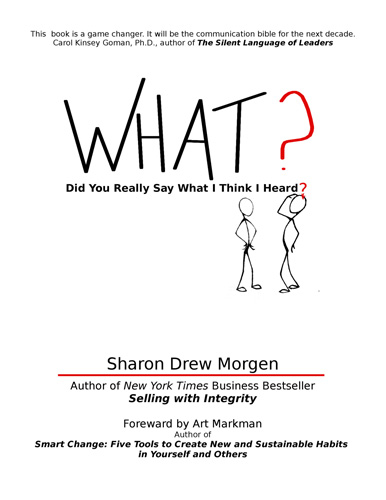
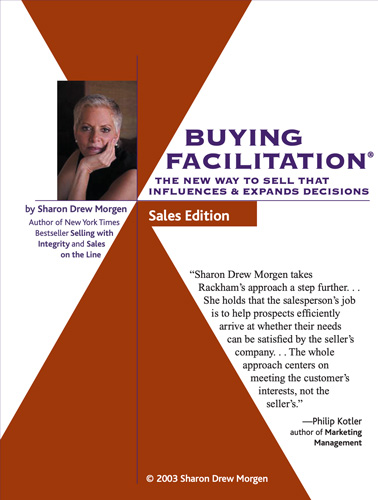
Due to the several distortion and deletion processes involved when the Listener’s brain ultimately translates incoming words, we end up accurately understanding less than 35% of a Speaker’s intended message. I’ve written a book explaining this if you’re interested:

To make it worse, incoming/spoken words are ultimately translated by existing (historic) neural circuits, making it probable we end up ‘hearing’ some rendition of what we’ve heard before, potentially causing flawed understanding and misguided assessments.
In other words, both Helper and client unwittingly mishear, mistranslate or misunderstand the Other regardless of intent or skill level. With potentially flawed understanding, Helpers and client make assumptions based on what we think we heard. An easy mind hack for this is to say “What did you hear me say?” or “I’d like to tell you what I think I heard to make sure I’ve understood you correctly” during important meetings.
This completes Part 1 of A DIRECT ROUTE TO FACILITATING PERMANENT CHANGE. Part 2 will be published next week and includes: Questions, Perceptual Positions, Mind Hacks, Model in Action.
_______________________
If you’re enjoying these Monday Articles, please subscribe to make sure you get them delivered to your inbox on Monday morning. I use no cookies, they’re free, and I never use the database to market. As an original thinker I offer these to share out-of-the-box ideas as part of my life’s work. And I’m always eager to hear your thoughts and start a conversation: sharondrew@sharondrewmorgen.com. Enjoy.
_______________________

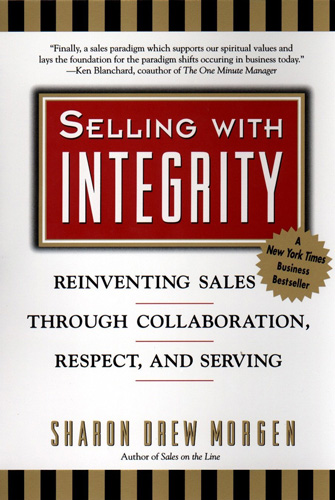
Sharon-Drew Morgen is a breakthrough innovator and original thinker, having developed new paradigms in sales (inventor Buying Facilitation®, listening/communication (What? Did you really say what I think I heard?), change management (The How of Change™), coaching, and leadership. She is the author of several books, including her new book HOW? Generating new neural circuits for learning, behavior change and decision making, the NYTimes Business Bestseller Selling with Integrity and Dirty Little Secrets: why buyers can’t buy and sellers can’t sell). Sharon-Drew coaches and consults with companies seeking out of the box remedies for congruent, servant-leader-based change in leadership, healthcare, and sales. Her award-winning blog carries original articles with new thinking, weekly. www.sharon-drew.com She can be reached at sharondrew@sharondrewmorgen.com.