
 Salespeople know the likelihood of closing a sale is small (less than 5%). Leaders understand the prospect of avoiding resistance during a project is unlikely (a 97% fail rate). Doctors realize the chances of patients following their suggestions are low (95% don’t follow doctor’s orders). Trainers are aware there’s a high probability (80-90%) their audience won’t retain what they’ve been taught.
Rationalizations make sense of the failures: it’s the buyer’s fault for not buying; the stakeholder’s fault for not wanting to change; the patient’s fault for not wanting to be healthy; the student’s fault for not being motivated to learn.
What if none of that were true? What if the models themselves were at fault and the industries merely build in their failure as the price of doing business rather than making a few small changes to achieve excellence?
DOING THE SAME THINGS EXPECTING DIFFERENT RESULTS
Each industry continues doing the same things they’ve always done regardless of the decades-long failure rates (Shouldn’t they be indicators? Isn’t that the definition of insanity?), blaming the Other rather than recognizing the inherent problems.
Globally, in learning institutions, corporations and consulting groups, people teach and apply the same problematic models and ideas that have been accepted through time and adopted as Truth, regardless of their failures.
I was horrified to learn recently that a man I dated decades ago has been teaching my original Facilitative Questions™ to his Harvard MBA students without license or training. I called him.
SD: But I never licensed you! Or taught you how to formulate them! They took me 10 years to invent and take days to learn!
A: I heard you use a couple of them. I figured out the rest myself.
SD: How does your interpretation get to the right neural circuits in the Listener’s brain to help them get to their source criteria for decision making?
A: WHAT? I don’t know anything about that. I just do it my way. They’re just questions.
SD: No, they do not gather information, nor are they based on curiosity. They’re brain-directed tools that make it possible to avoid automatic assumptions so people can quickly make criteria-based decisions.
A: I don’t know why you’re making such a big deal of this.
SD: Well, you’re using my IP, my coined and legally defined term to apply to a conventional practice (questions) that’s so biased there’s no way to capture good data or help anyone make a values-based decision. Not to mention you’re teaching future leaders the wrong thing!
A: They don’t know the difference.
This is how original ideas get quashed and perpetuated: stealing original ideas from the inventors, redefining and misusing them to fit standard thinking, and then propagating them regardless of the cost. And it gets normalized endlessly.
ORIGINAL IDEAS GET IGNORED
As an original thinker I invent, train, and write books on systemic change models that enable Others to discover their own, usually unconscious, answers – which they must do anyway as part of their decision making process.
My models include skills and ideas that run counter to standard thingking: Buyers don’t buy based on solutions (and selling doesn’t cause buying!); leaders overlook first-hand, accurate knowledge before goal setting when they fail to include all stakeholder’s voices, assuring resistance later. When docs forget that patients need a belief change before they modify behaviors, they’re setting up non-compliance. When training models offer content before participant’s brains can accurately translate it, they cannot retain new knowledge.
None of the current models have specific skills that enable Others to discover their own values-based answers and outputs. Rather, they’re rules- and culture-driven and fail to recognize the risks they instigate.
Change, after all, is a risk consideration: unless the risk of change is known and managed, unless the underlying values of the new match the original values, no change will occur: The risk of change must be lower than the risk of staying the same or the status quo prevails.
And standard thinking lacks the tools to guide Others – learners, buyers, clients, patients – to recognize and manage their risks, assuming instead that good information, stories, content, or explanations will provide the ‘proof’ to buy, learn, change.
WHERE STANDARD THINKING GETS IT WRONG
Standard thinking assumes ‘good’ or ‘rational’ information, delivered by someone with ‘credibility’ (a seller, a coach, a leader, a doc, a trainer) will convince and cause change. It doesn’t: information is needed only after a risk gets uncovered and managed, and after the values criteria are engaged. Otherwise there’s no way to know what information is needed.
Not only can there be no evaluation unless the risk is known, brains can’t easily understand content that doesn’t already exist within their historic brain circuitry: Due to the way brains listen, how they receive and translate incoming words/sound vibrations, what we think we hear is unwittingly translated according to what we’ve heard before – all but guaranteeing the status quo continues.
Obviously, this causes all incoming content – pitches, presentations, incentives, stories, and ‘rational’ explanations – to be misinterpreted when it goes against a listener’s history and beliefs.

CASE STUDIES
A Sales University
I had an unnerving experience in early 2000 that exemplifies how standard thinking prevails regardless of the possibility of adopting new ideas that have a better chance of success.
In the 1990s I keynoted at a sales university. Prior to my talk, I took the opportunity to listen to other speakers and sit in on workshops that taught standard sales models (how to place solutions and counter objections – the Sell Side). I never once heard mentioned the differences between selling and how buyers buy, a separate and unique values-based, risk-avoidance process all folks must go through before being willing to buy.
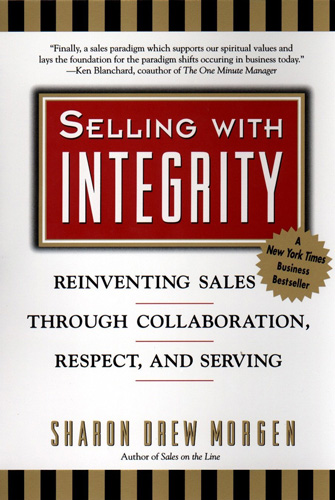
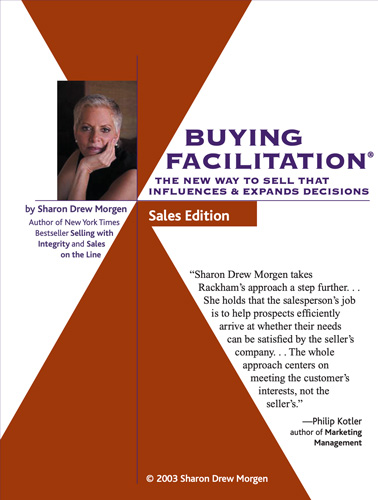
I must admit I was surprised. My book Selling with Integrity had been on the New York Times Business Bestseller’s list and the reason I was hired for the job. Given the number of copies the book sold I (naively) thought people were at least considering adding tools to first facilitate buying decisions to their selling activities.
Knowing I was fighting an uphill battle to change an industry that had been around since the Serpent convinced Eve to eat the apple, I carefully prepared my talk to at least inspire curiosity. I also spent my own money ($3,000, against my $5,000 pay!) to purchase hardcover books for the audience of 200 that I placed on each chair.
About 10 minutes into my talk, audience members began leaving. Because my ideas went against what they were being taught, and even though Buying Facilitation® would enhance their close rate substantially and instigate trust, they couldn’t even consider my ideas. By the end of my talk there were 9 people left in the audience. And every single one of my books was left on the chairs. Not one – not one – seller-in-training thought my book (free! a NYTimes Bestseller!) worth taking.
Dug in Leadership
Here’s another story:
I once sat next to a well-dressed young man on a flight to Seattle.
SD: You look very professional. I assume you’re going to meet a prospect?
Man: Yes. I’m hoping he likes me well enough to allow me to provide free services for two weeks in hopes they’ll hire me.
SD: So you’re using your body as a prospecting tool. What would you need to believe differently to be able to facilitate your prospect into choosing you without you working for 2 weeks without pay?
Man: You sound just like this book I just read! (My book, of course). She made a lot of sense.
SD: So why aren’t you using her suggestions?
Man: I gave my boss the book and told him I wanted to work with her to learn how to help buyers buy. He read it and told me she was crazy, that sales doesn’t work that way and not to use any of her ideas.
No, sales doesn’t work that way; facilitating buying decisions does. In both case studies, standard thinking prevailed, regardless of the cost.

WHEN IS IT TIME TO CHANGE?
It’s time we re-examine our assumption that our established models represent Truth.
Indeed, information is the last thing people need when deciding to make a change (see my 13 steps of change).
What needs to happen for standard thinking to evolve beyond current failed processes? When will sellers and leaders and doctors and trainers realize it’s their own models causing the failures – and maybe it’s time to consider adding new skills?
Is it really worth the cost of failure to continue doing what you’ve always done? Yes, it takes courage to do something different. But what’s the risk if you don’t?
______________________________
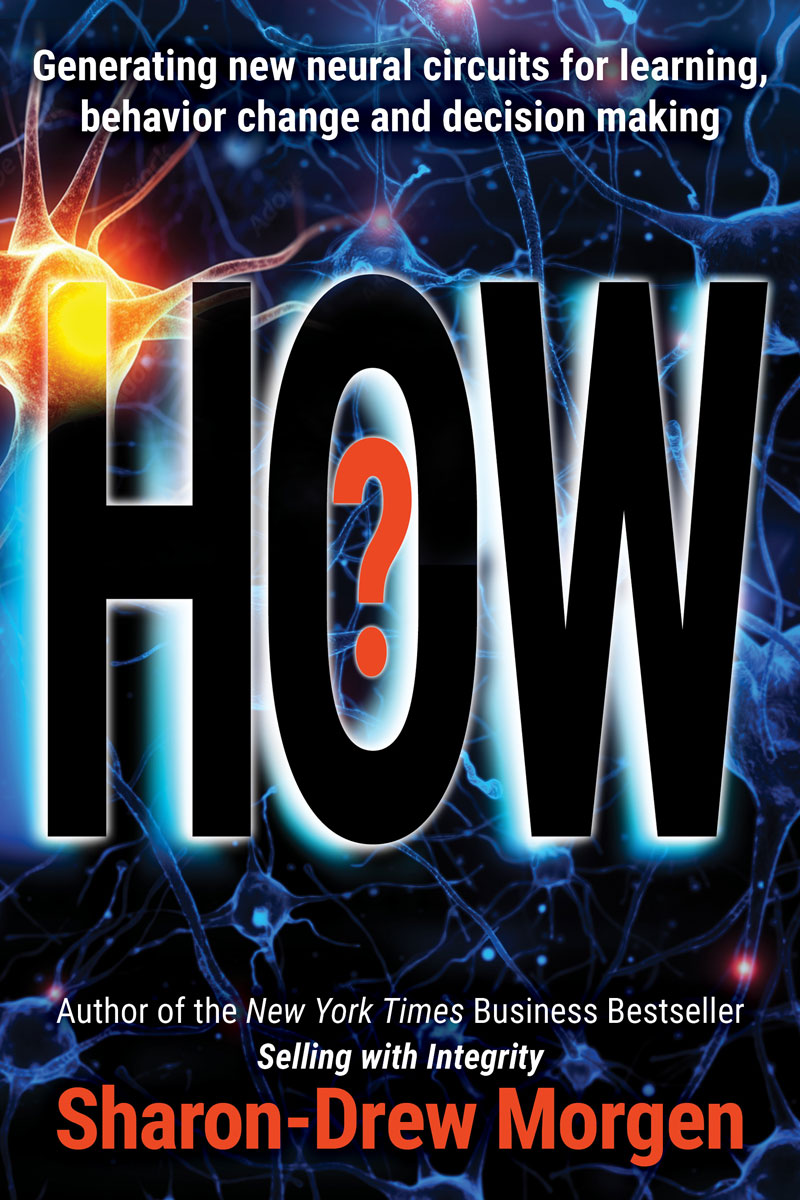
Sharon-Drew Morgen is a breakthrough innovator and original thinker, having developed new paradigms in sales (inventor Buying Facilitation®, listening/communication (What? Did you really say what I think I heard?), change management (The How of Change™), coaching, and leadership. She is the author of several books, including her new book HOW? Generating new neural circuits for learning, behavior change and decision making, the NYTimes Business Bestseller Selling with Integrity and Dirty Little Secrets: why buyers can’t buy and sellers can’t sell). Sharon-Drew coaches and consults with companies seeking out of the box remedies for congruent, servant-leader-based change in leadership, healthcare, and sales. Her award-winning blog carries original articles with new thinking, weekly. www.sharon-drew.com She can be reached at sharondrew@sharondrewmorgen.com.