
 In my 40 years of training and coaching sellers, coaches, doctors, leaders, and System Dynamics practitioners, I have never met anyone considering what’s happening on the other side.
- Sellers offer content details as their primary tool but overlook the decision process and risk management issues buyers must navigate before buying;
- Healthcare providers spout viewpoints and directions but overlook the internal belief change processes necessary for patients to make permanent changes;
- Leaders lead from their ideas and assumptions but overlook the need to include and facilitate stakeholders to buy-in to values-based change to avoid risk and resistance;
- Coaches pose questions from their own assumptions that fail to uncover the client’s unconscious values-based criteria necessary for change;
- Trainers offer great content, but don’t address how learners hear or retain what’s been said;
- Questioners formulate questions from guesses, needs and assumptions without understanding or considering the responder’s needs or reality.
- Companies and retail stores only think about their bottom line and forget to account for customers.
Standard models assume that whatever Influencers share will be
– heard as intended,
– appropriate for the situation,
– accepted as fact,
– executed as specified.
But none of that is true: these one-way models generally:
- fail to address the core choices and feelings, understanding and beliefs, management of personal and cultural risks and reactions that need to be addressed for real change;
- don’t get heard accurately: due to the way incoming words are translated by the brain, people can’t accurately hear what was said. Filled with distortions and deletions, the brain’s ‘listening’ process causes people to accurately hear less than 35% of the intended message;
- make it difficult to assess mutual understanding or acceptance;
- are driven by the needs and assumptions of the Influencer and don’t get buy-in because all stakeholders aren’t represented.

RESPONDERS MUST BE INCLUDED
We forget the importance of giving Others their own agency. When new sellers are hired they’re taught details of their product – and overlook how buyers buy (the Buy Side addresses Pre-Sales, non-solution oriented change management issues). Coaches are taught to ‘actively listen’, and pose ‘powerful’ questions – but ignore their client’s sometimes unconscious risks of change (a separate calculation from the problem to be solved).
Trainers are taught instructional design and engagement methods – and don’t include how learners learn (a separate activity than acquiring new content). Doctors instruct patients on what they must do differently – and fail to account for a patient’s internal calculations for habit change (without which the instructions won’t be executed). Leaders form their goals from their own assumptions and fail to include the stakeholders (who then resist because they’ve been ignored).
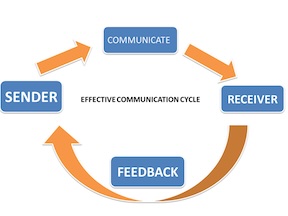
Most influencers don’t even consider the ‘other side’. And when they fail, they blame the buyer, the client, the student, the patient forgetting that real communication is not one-sided but circular.

Indeed, when there’s only a Sender, there’s no way to know how or even if the Responder has understood, is confused, or is willing to make a change. When both Sender and Receiver are involved, problems, needs, resistances, areas of confusion, beliefs, fears, or understanding can emerge.
WE EACH LIVE IN DIFFERENT REALITIES
As outsiders we’ll never understand another’s unconscious, internal triggers – but we can help them find their own to make changes appropriate to their own beliefs.
I believe our job as Influencers is to guide Others through their own discovery and change process without perscriptives. Ultimately the end result will meet the Influencer’s objectives, but not necessarily conform with the Influencer’s suggestions.
Below is a great example of how it’s possible to enable Others to discover their own best values-based criteria to solve a problem where Influencers believe a change is needed – and how the doc’s directions actually kept his patient from discovering her own choice criteria and achieving her goals.
And note: this Change Facilitation process can be used in any profession, but it requires a different goal (facilitate Others to their own answers) and different skills (i.e. listening without bias, Facilitative Questions™ that get to specific internal triggers, etc.).
A PATIENT-LED CASE STUDY
Maria came to my house crying. Her doctor had told her she was borderline diabetic and needed to eat differently. He gave her a printed list of foods to eat and foods to avoid and sent her on her way. She tried to follow the list for months, lost some weight, but finally gave up and went back to her normal eating habits and gained back the weight. But she was fearful of dying from diabetes like her mother did. Apparently something beyond the fear of death was holding her back from changing her eating habits. She asked if I could help. Here was our exchange.
SDM: What has stopped you from following the doctor’s food choices?
Maria: I want to keep my family’s love. (Seems it was a highly valued criteria that surpassed death.)
SDM: I hear you’ve combined food and love.
Maria: Of course (A very strong belief that needed to be included for any change to occur.)
SDM: How are you currently using food in a way that causes love, and how does that affect your weight gain?
Maria: I make 150 tortillas each morning and hand them out to all my children and grandchildren who come by on their way to work and school in the morning. Then Joe and I eat the rest. My family loves my tortillas. I know they’re bad for me with all the lard in them, even though I eat them. But I get to see my whole family every day! When the doctor told me I can’t eat them anymore, it felt like he asked me to not love my family.
SDM: So I hear that handing out tortillas has kept you connected with your family. Since they’re unhealthy for you, is there any other way you can be connected through food without putting your health at risk?
Maria: Hmmmm… I could make them frittatas, but they’d take a lot longer. But I’ve got an idea…
Maria invited her entire family for dinner and told them she couldn’t make tortillas any more due to health reasons. She presented her daughter Sonia – the new Tortilla Tia – with her tortilla press outfitted with a big red bow, saying Sonia would be making their morning tortillas Monday through Thursday BUT to come by her house on Friday’s and she’d have frittatas for them.
This simple switch incorporated her idiosyncratic, and very real, need to link food and love, and begin a healthy eating plan AND meet her criterria to connect family love with food. It also inspired her to research food substitutions she could easily make to avoid a chronic illness. Eventually, she lost 40 pounds and had a food plan more closely aligned with what her doc suggested. And of course, she could still make her family happy with her food and meet her beliefs.
A DIFFERENT HAT
As you can see, entering the problem with a goal to enable Others to figure out their own route to change instead of trying to drive it with personal assumptions and instructions, and using a different curiosity and a different questioning system, it’s quite possible to guide people to discover their own best choices that are congruent with who they are.
Trusting Others have their own answer is core. But that means Influencers must be willing to forego their need to be right, give up their top down control, and trust Others have their own idiosyncratic and belief-based criteria for making a change.
We must be willing to go beyond our own side of the equation. With the high fail rate in each industry, I would think there’s a realization of the necessity to include Others in the calculation. After all, if buyers don’t buy, patients or clients don’t change, and resistance impedes success, we’ve failed at our job.
Seems to me we should be considering doing something different. If you’re interested in learning the Change Facilitation model and new questioning system, please contact me. sharondrew@sharondrewmorgen.com
____________________

Sharon-Drew Morgen is a breakthrough innovator and original thinker, having developed new paradigms in sales (inventor Buying Facilitation®, listening/communication (What? Did you really say what I think I heard?), change management (The How of Change™), coaching, and leadership. She is the author of several books, including her new book HOW? Generating new neural circuits for learning, behavior change and decision making, the NYTimes Business Bestseller Selling with Integrity and Dirty Little Secrets: why buyers can’t buy and sellers can’t sell). Sharon-Drew coaches and consults with companies seeking out of the box remedies for congruent, servant-leader-based change in leadership, healthcare, and sales. Her award-winning blog carries original articles with new thinking, weekly. www.sharon-drew.com She can be reached at sharondrew@sharondrewmorgen.com.