




Currently LLMS and bots largely gather and express data and generate content restricting responses according to the historic datasets, tokens, architecture, and training framework that employ patterns to utilize information. I offer a unique capability for values-based decision making:
FacilitationAI is a flexible, scalable API with SDK that works with LLMs and applications to formulate and prompt a self-generated sequence of brain-directional questions that lead to values-based criteria for decision making.
As a decisionmaking tool that gets to the source – the synapses – where decision criteria are stored in the brain, FA instantiates an API embedded within an application. By using specific wording in specific sequences that get directly to the precise synapses that hold a User’s unique decision-making criteria, it adds new dimensionality to causal.ai and generative.ai.
How I see the world differently problematic
I’ve spent decades unpacking the automatic, physiological, systemic, and neurological routes to neural circuits where beliefs and values are stored (the foundations for all personal decisions and change) and have invented several decision-making and change models. One of my inventions is a unique form of question (Facilitative Questions) that traverses the steps of decision making I developed and go on to connect with specific neural circuits that hold the criteria for decision making.
What’s different?
With a shift in intent – a tool to capture criteria and generate questions, not provide/generate data from a prompt – Questioners will be led to the neural circuits that hold their belief-based answers to make a good decision.
Currently,
- LLMs and chatbots are organized around information and content extraction/creation, yet decisions that cause change or alter behaviors emerge from foundational, personal, values-based criteria and beliefs. There are no APIs that respond with unique sequences of questions where decision-making criteria are stored.
- Q: Am I ready to break up with my boyfriend?
- FA response: Until now, do you have a history of successfully ending any long-term relationships?
- NOTE: This would be the first Facilitative Question in a sequence that would ultimately lead to a Questioner finding previous successful choices stored in hard-to-reach (i.e. not superhighway) circuits. OR if there are none, would trigger new circuit generation for permanent behavior/habit change.
- APIs capture and output data that’s reductive and generic; none trigger responses to direct a Questioner to where their unconscious values/belief-based criteria are stored for high level decision making and choice.
- Q: How can I maintain my weight loss?
- FA: Has there ever been a time you’ve successfully changed a habit?
- NOTE: This Facilitative Question is the first of a series of questions that would lead a Questioner through a specific sequence to find the neural circuits that have prompted choices previously OR, if no incidents, would generate new neural circuitry to change a habit.
FA would shift the focus from information-gathering and generation to question generation.
Business Model:
With a broad range of uses across industries and contexts, for business and personal use, FA will provide consistency, uniqueness, personal empowerment, and integrity. It is uniquely positioned to be licensed by OEMs and resellers, ai development companies, hospitals and healthcare providers, schools, coaching, etc.; and for personal use to change health habits, resolve personal quandaries, clarify long-term choices.
Use Cases:
When having difficulties making important decisions, people rely on friends or hire professionals for help. Sometimes people have health issues that require permanent behavior/habit changes; sometimes professionals need help figuring out how to help teammates through to a joint belief to solve a problem.
As a first use case, I’ll focus on the field of Healthcare, including:
*Belief, behavior and habit change *Habit creation *Permanent weight loss *Change diet and eating habits/improve nutrition *Manage addiction (Self or Friend) *Remaining sober *Decision making: making new life choices for Self or as Caregiver; *Committing to better, more consistent, exercise habits *End of life choices *Decisions re timing for hospice/nursing home for family members
Output:
Because FA is a self-directed question generator, the output is different from current chatbots or causal/generative.ai.
- Reduced time to make decisions: By generating Facilitative Questions that enable high quality decision making quickly, FA reduced the time to make decisions.
- Useful for personal situations
- Useful to enable folks with health issues to change habits permanently
- Useful for relationship, collaboration, and partnership problems
- Avoid bias in questions: By avoiding the natural bias within conventional questions that restrict information extraction and generation, Facilitative Questions extract values-based criteria to create follow-on questions that eventually discover the foundational standards for a unique situation.
- Obtain unconscious criteria: By sequencing Facilitative Questions to uncover the unconscious criteria underlying personal choice, FA avoids resistance.
- Ethical: Because FA generates questions that trust the User has their own answers, it’s an ethical, integrous model with no manipulation, guesswork, or influencer/persuasion tactics.
- People deciding on whether or not to make a purchase would uncover their criteria for buying.
- External influencers wouldn’t affect a values-based decision.
- People with health issues would discover their own routes to changes in diet, exercise etc.
- Students deciding on whether to attend college; caregivers could decide on timing for changes in living arrangements; battered women could quickly decide whether/when to leave; people in delicate negotiations could determine acceptable criteria. The list encompasses all personal decisions.
- Different focus of control for generated responses: Because control shifts from finding patterns to extract choices, to using self-generating values patterns to formulate another question, Users are in control. The discovery of values/belief-based criteria that underlie congruent decision making shifts current ai output to discovering the underlying, unconscious beliefs held by the User and generating self-directed Facilitative Questions.
- Instead of attempting to find the best available answers when making a decision, making a purchase, choosing a healthcare routine, etc, Users will access their own criteria for choice.
There are potential downsides to developing this new capability:
- While the use will be obvious real-time, marketing will be unique, as most people assume that good information generates good decisions. It can, but only after belief-based criteria are met; otherwise there’s resistance to the information regardless of its efficacy. Marketing would need to enable understanding and design use models while maintaining the integrity of the solution.
- Right now, the solution is dependent on Sharon-Drew Morgen. While the questions are scalable, question formulation must be trained and programmed. This could potentially be a business opportunity.
- It would be necessary to develop different data sets and tokens, possibly different model architectures and training frameworks.
Conclusion:
Imagine an ai capability that helps people find their own best answers to make decisions from their own values and history of success, or that generates questions that enable new brain circuits for new habits and behaviors…and then ultimately connecting with causal/generative.ai to get the details.
Until now, ai and LLMs have focused on collecting, generating, using data, with no simple capability to facilitate non-data-driven, personal beliefs/values-based answers. With FA, it would now be possible to use ai more extensively, with a broad use-base. This would make an important contribution to ai.
Team:
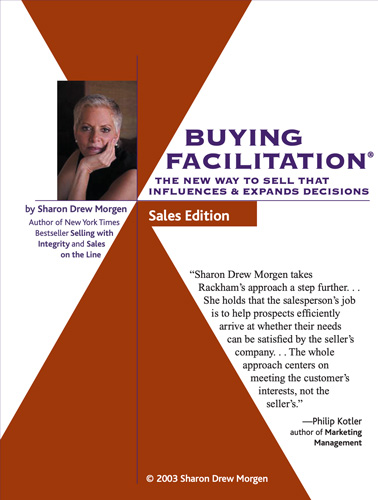
Sharon-Drew Morgen CEO / Founder
Sharon-Drew Morgen is an original thinker, New York Times Business Bestselling author of 10 books and 1000+ articles, and inventor of several systemic brain change models she’s trained successfully to appx 100,000 sellers, leaders, coaches, and managers in global corporations since 1987. She’s founded a successful tech support company in the UK in 1983 ($5,000,000 revenue in just under 4 years, with no internet.) and a non-profit that’s now 40 years old and spans several countries. As the inventor of Facilitative Questions, a noted original thinker, and a proven start-up leader, Sharon-Drew is uniquely qualified. www.sharon-drew.com www.mind-brainconnection.com