


 Part 1 includes Listening, Brains/Change, Assumptions, and Risk.
QUESTIONS
For those who use questions as part of the Helping process, your questions may not be gleaning a full, or accurate, data set.
Many of us use questions to gather complete or accurate data, assuming
- we formulate unbiased, targeted questions that will be heard as intended and provide good information;
- our questions extract the information necessary for assessment and mutual comprehension or cause introspection;
- Helper and client can accurately hear what the other says and means;
- we need information to facilitate a client’s change;
- clients need us to guide them when they’re stuck;
- we’re not causing any risk to the client.
Like everything we say, standard questions are formulated and biased by the needs, goals, and assumptions of the Asker, making the above assumptions flawed:
- standard questions are biased by our assumptions and goals and may not be heard as intended;
- standard questions may not extract accurate or complete information;
- standard questions get to the conscious mind, not to the unconscious, electrochemical neural circuits where values-based criteria are stored and where change/decision making are triggered;
- neither Helper nor client can accurately hear/understand each other;
- information doesn’t reorient a client’s unconscious;
- because the presenting problematic issues come from the unconscious brain, neither client nor Helper know what’s at risk initially.
I’ve invented a wholly new form of question (Facilitative Question™) that alleviates these issues and are formulated in a very specific way to reach the specific neural circuits that hold the elements that will trigger the preferred change. They’re used with a 13 Step Change model that consciously gets to the unconscious for permanent change. I call them ‘brain directional’,
- designed to find underlying systems, not gather information;
- causing Listeners to get into a witness/meta state;
- are posed using specific types of words and phrases in very specific sequences;
- require a goal of discovery rather than assessment or understanding.
Here’s a simple comparison between a standard information gathering question:
Why do you wear your hair like that?
and one that leads the Listener to unconscious discovery:
How would you know if it were time to reconsider your hairstyle?
This Facilitative Question™ (FQ) might begin a sequence that leads the Listener to several neural circuits that encapsulate the systemic elements in a change decision. The FQ above captures elements in of the Listener’s system that must be included if they were to, say, have trouble deciding on a new ‘look’ – in this case, time, historic comparators, willingness to change, and a change in mental perspective.
While a simple example, it gives you an appreciation of the difference in skills needed to help clients get to their unconscious triggers: it overrides the conscious biases and gets directly to the unconscious.
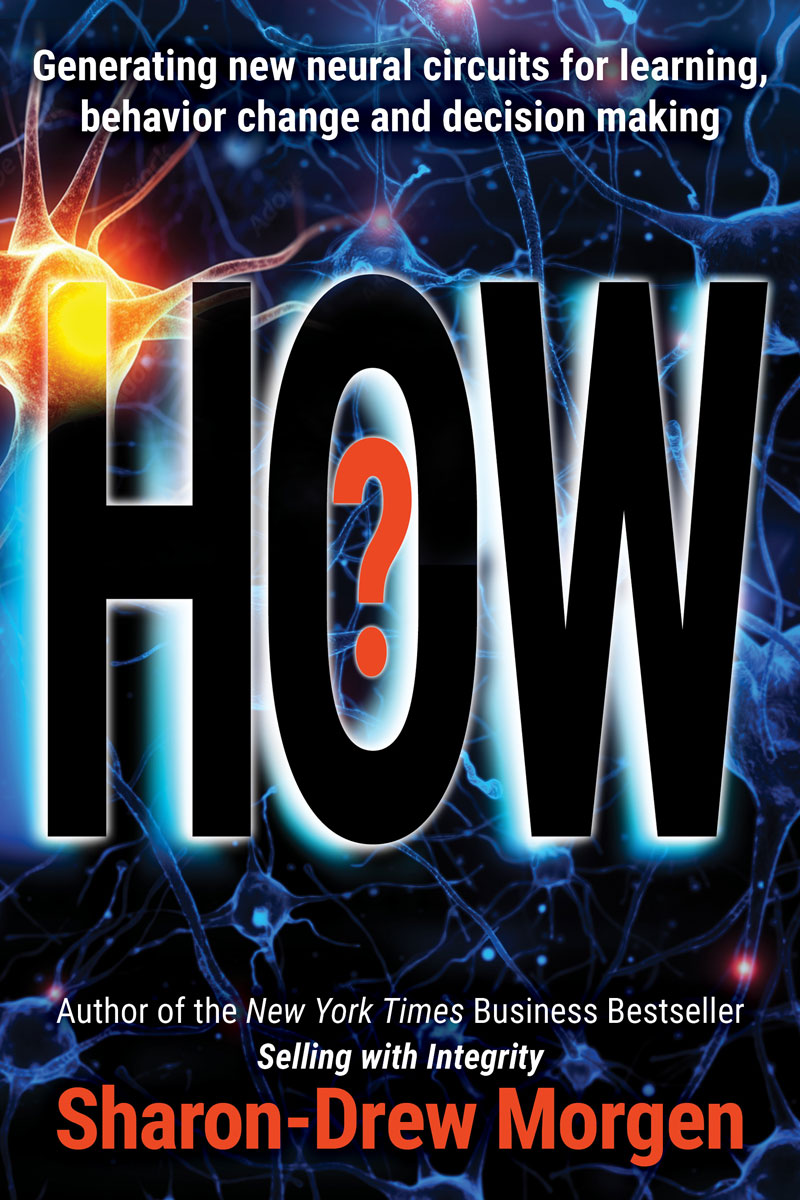
My book HOW? has a 100-page chapter on how to formulate the FQs, or you can purchase a Learning Accelerator. Both will teach you how to switch Perceptual Positions, listen in Observer, understand the sequence brains take when generating activity and how to ensure the questions are formulated to match the sequence. They cut through bias and enable the brain to find the right circuits necessary to maintain Systems Congruence and achieve systemic buy-in for a new decision.

THE OLD AND THE NEW
When clients approach us to help them get unstuck , we assume
1. we must gather information to ’assess’ and understand their current situation. That’s certainly true when diagnosing illness or a car breakdown, or to identify a misunderstanding, for example. But
a. neither Helper nor client accurately hear each other,
b. standard questions can’t extract unbiased or complete information,
c. Information is the last thing needed in decision making,
d. clients don’t need us to understand their specific story details in order to make a change.
Clients have the elements necessary for new solutions stored amidst trillions of neural circuits in their brain and only need help finding them.
e. because we each have unique mental models (subjective) and listen through our brain’s subjectivity, outsiders cannot fully understand what’s going on as we can’t understand each other.
2. we have the tools, mindset, experience, and care to help clients resolve problems once we understand the goals and problems involved. Clients can understand their own issues, make their own assessments, and plan their own strategies when they find the values-based circuits that triggered their situation.
It’s possible to lead clients to the origination points in their brain that triggered the current problems and from which they can generate new values-based solutions.
3. our curiosity, expertise, and assumptions can uncover the issues causing the problem. Our queries and data gathering are directed at the conscious mind where information is stored and don’t get to the neural circuits in the unconscious where decision criteria reside.
All outputs (behaviors, choices) arise from neural circuits in the unconscious where our values-based criteria are stored, and not readily available to respond to direct questions that seek to extract historic information stored in the mind – and may not even be heard as intended.
4. our ultimate job is to facilitate permanent behavior change or congruent decision making in alignment with the client’s beliefs and values. We can’t help clients change their behaviors permanently by merely trying to help them change the outputs. We must help them generate new circuits that trigger new behaviors and contain the systemic elements to maintain Systems Congruence.
Once the origination points are discovered and modified, or new circuits generated, new behaviors emerge automatically.
Using this thinking our job transitions from understanding, assessing, assuming, or guiding to being real facilitators that lead clients to their unconscious circuits where the offending behaviors and choice originate so they can discover and design their own answers from the source.
HELP CLIENTS FIND THEIR ANSWERS
While I passionately believe it’s vital for clients to share thoughts, unwrap feelings and get feedback (Full disclosure: I spent 12 years in talk therapy, 15 years in group therapy, and have three NLP degrees – Practitioner, Master Prac, and Beyond) I now believe the portion of the change process dependent upon unconscious change can be shortened.
I suggest we need new tools: to listen differently (for systems, metamessages, patterns instead of information) to hear/recognize metamessages and the client’s systems, and new bias-free questions that and lead clients directly to their unconscious drivers (rather than remain in their conscious story-lines).
One of the most important elements necessary to facilitate change: choice in Perceptual Positions.
To accurately listen for metamessages and patterns, to avoid bias and restriction, to know where to place and formulate a question, we must move beyond our natural curiosity or assumptions.
A simple way to achieve this is to shift Perceptual Positions (moving between different viewpoints) from listen-for-understanding position to a coach/witness/meta position that offers a neutral, detached, less biased perspective. And I’ll stop here for a moment: I’m aware that different practices define ‘Self’ differently than I do. For this paper, I define Self as being in your natural, automatic, instinctive, unconscious viewpoint (Self), where we reside most of the time.
The Self viewpoint is where we hold our unconscious biases.
Self: subjective, automatic, natural, instinctive, unconscious, restricted, detailed, out-of-choice, (re)action/emotional, mind-based, content.
Sometimes we need a neutral way to listen that provides a offers a broader range of choice and options and makes conscious choice possible. If you’ve ever been with a small child who’s writing on a wall, you’ve made an automatic, unconscious, quick mental switch – from screaming (Self) to a more thoughtful (Observer) choice that would subvert the toddler to paper coloring instead of walls. I call this change of perceptual stance the Observer position. We all do it unconsciously, but I suggest it must be a conscious choice when working with clients. So:
Observer: objective, witness, broad range, rational, brain-based, minimal emotion, conscious choice, voluntary, meta, unbiased, neutral.
Listening from Observer seems to go around normal listening biases, and more accurately hear your client’s intended message. It also provides a broad, neutral view. And no, you won’t hear many details (from Observer you’re not listening for details/content anyway) but you’ll hear patterns, metamessages, underlying beliefs and assumptions where you both can recognize the where current choices were made and the underlying values necessary for proposed change.
I work with all of my clients and students while in the Observer position to avoid bias. Try it.
CONCLUSION
As you can see, our general Helping practices may not facilitate clients through to lasting change due to the way our brains process information:
- We can’t understand each other and can only accurately hear a maximum of 35% of what’s said.
- Our questions are biased by our own assumptions and goals and can’t extract accurate information.
- We seek information from a client’s mind, and their change capability is in their brain.
- It’s not possible to change behaviors by trying to change behaviors. For permanent behavior change, it’s necessary to generate new neural circuits in the brain.
While it’s possible our current models may eventually trigger new neural circuits, it’s not a certainty, it’s inefficient and it might be risky for them unconsciously.
For times when you are helping Others reach their best decisions or need help changing patterns, assume they have their own answers that are merely difficult to find amidst 100 trillion neural circuits where they’re currently stored. It’s far more effective to help folks find these circuits rather than conventional helping, or coaching techniques dependent on gathering, assessing, brainstorming information that has a high probability of being misinterpreted.
I teach skill sets for Helpers to lead clients to their offending neural circuits or generate new ones for permanent change. For those who merely want a quick fix, use these questions below – a mix of standard and Facilitative Questions™, as a guide.
- Listen for systems, patterns, beliefs.
- Listen from Observer.
- Ask the following questions, in this specific sequence (although they may iterate):
a. Where are you now?
b. What’s stopping you from X?
c. What would you need to know or believe differently to do X instead of Y?
d. How would you know when it’s time to X?
Once clients have discovered where their presenting problems came from, they will need you to extract specific information as to what else is needed, brainstorm from the new revelations, deliver additional information and create an action plan. But by then, the client has already discovered their answers.
For those who want more detailed information or learn how to facilitate change from the unconscious triggers in the neural circuits, email me to either get more complete answers or take training. sharondrew@sharondrewmorgen.com. For those of you who want to learn it on your own, get my book HOW? as it teaches how, specifically, to generate new circuits.
Remember: clients already have their own answers stored in difficult to find circuits among the 100 trillion in their brain. Your job is to help your clients find them. What would you need to believe differently to be willing to facilitate/enable an Other to define and discover the criteria they’d need to match to make a good decision?
For those interested in seeing this model in action, I presented a paper at the Columbia University Learning Ideas conference in 2024. Enjoy. https://tinyurl.com/45tsf
Part 1 includes Listening, Brains/Change, Assumptions, and Risk.
_______________________
If you’re enjoying these Monday Articles, please subscribe to make sure you get them delivered to your inbox on Monday morning. I use no cookies, they’re free, and I never use the database to market. As an original thinker I offer these to share out-of-the-box ideas as part of my life’s work. And I’m always eager to hear your thoughts and start a conversation: sharondrew@sharondrewmorgen.com. Enjoy.
_______________________

________________________________
Sharon-Drew Morgen is a breakthrough innovator and original thinker, having developed new paradigms in sales (inventor Buying Facilitation®, listening/communication (What? Did you really say what I think I heard?), change management (The How of Change™), coaching, and leadership. She is the author of several books, including her new book HOW? Generating new neural circuits for learning, behavior change and decision making, the NYTimes Business Bestseller Selling with Integrity and Dirty Little Secrets: why buyers can’t buy and sellers can’t sell). Sharon-Drew coaches and consults with companies seeking out of the box remedies for congruent, servant-leader-based change in leadership, healthcare, and sales. Her award-winning blog carries original articles with new thinking, weekly. www.sharon-drew.com She can be reached at sharondrew@sharondrewmorgen.com.