


 Do you ever wonder why so few prospects close when it’s obvious they need your solution? Why even after meetings (that took untold tries and so much wasted time to set) you close only 5%? The problem is simple: sales is not a prospecting tool.
Sales is a solution-placement model that provides details – features and functions – of your solution so people know how it fits with their needs. I call this the Sell Side. While vital, it doesn’t find, or facilitate buyers. In fact, selling (in and of itself) doesn’t cause buying.
It was initially developed by Dale Carnegie who, in 1937, had many good reasons to seek Others with a need: prospects were neighbors who had few other options and no ways to compare product details; their risks of change were minimal; and they had no ‘buying decision teams’ per se.
SALES DOESN’T FACILITATE THE DECISION PROCESS
While that’s all changed in the past 90 years, the sales model continues to use the same toolkit and goal: sell. But with so many providers offering similar solutions and the technology to compare options; with alternatives (workarounds) to your solution; with unknown decision makers and risks to be managed, the standard sales model doesn’t have the tool kit to facilitate the prospect’s comprehensive decision process.
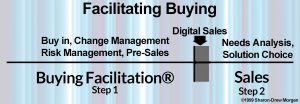
The time it takes people to assemble the right decision makers, get buy-in, and figure out the elements involved in their risk of change, is the length of the sales cycle. Regardless of the need or the efficacy of the solution, a buying decision will not risk disrupting the system. Until or unless the risk of change is less than the risk of bringing in a new solution, they will not buy. A closed sale occurs when all decision makers buy in and risks are known and addressed. This is the Buy Side.
The focus on ‘selling’ puts sellers at a profound disadvantage: since it focuses on placing solutions, and uses ‘need’ as the justification, it can only succeed
- with folks who have already done their internal decision making
- have gotten buy-in from those involved (i.e. the Buying Decision Team)
- recognize the risk of change to be minimal to their culture to bringing in something external.
And the sales model was not developed to do that.
Unfortunately, with only the solution-placement model at hand, sellers are stuck wasting their time trying – and spending vast amounts of resource – looking for the proverbial needle in a haystack, using content promotion (marketing), brand placement (advertising), seeking appointments (the decision makers don’t show up and it takes vast amounts of time to get one) and pitching to find those relatively-few folks who have done their internal change/risk management work, and are already ready, willing, and able to make a purchase.
DO YOU WANT TO SELL? OR FACILITATE BUYING?
Of course, sales is a necessary element in a buying decision. But to find and serve folks on route to a buying decision it’s necessary to use a different goal and toolkit to find and facilitate prospects through their messy and over-long decision-making process.
Right now, sellers use their product as the reason to buy, and dangle information, with price as the bait. But entering with product content and a solution-placement goal ensures there’s no way to
- generate a real relationship achieved when you facilitate people quickly through their steps of their change/risk decisions;
- find people on route to buying but not self-identified as prospects yet;
- close more than 5% (those ultimately ready to seek an external solution)
- compete against similar products, causing you to compete with price.
It’s like a construction worker with only a hammer. Without the full tool kit, it’s not possible to build a house. The hammer is necessary, but not as the only tool.
TWO BUYING PROCESSES
Obviously, with the ultimate goal to place solutions, it’s necessary to find people ready to buy them. But the sales model falls short and tries to sell to people who aren’t ready when it could be seeking people on route to becoming prospects and lead them through their change issues. They must do this anyway, and we wait – and wait, and offer lower pricing – while they do.
Right now, you’re using a ‘need’ filter to find prospects. But ‘need’ won’t find people already attempting to solve a problem internally (actual prospects) because they start off assuming they can solve their own problem and will ignore your outreach. Remember: external fixes carry the unknown baggage of risk and buy-in issues.
To avoid the pitfalls of wasted time and overlooked (actual) prospects, an additional set of goals and skills are necessary: shift your initial goal to seeking folks in the process of solving a problem your solution can solve, then facilitate them through their change/risk decision issues. I call this the Buy Side. And you’ll close triple what you’re now closing as you’ll be offering real support since all potential buyers must, must do this.

I’ve invented a decision facilitation/change management model (Buying Facilitation®) that begins by seeking folks already IN their process of trying to solve a problem (i.e. not needs based) your solution can resolve (people not yet self-identified as prospects) and facilitate them through their change/risk management, THEN sells when they’ve gotten buy-in.
Of course, during the facilitation process some people will discover that the risk of change is greater than the risk of staying the same and will never be buyers. Obviously, these folks aren’t your buyers, but you will discover this in minutes, and you will have developed a real servant-leader relationship with a chance they’ll come back later.
But ignoring these folks assures you of overlooking the 80% actual prospects that are on route to becoming prospects. It’s certainly better than filling their spam folder with your ‘reminders’ and pitches or finally getting a meeting with just one or two ‘prospects’ who won’t ever buy.
If your job is to sell, find folks on route to self-identifying as buyers – those who WILL buy instead of those who SHOULD buy. Learn Buying Facilitation® and a new set of skills (Facilitative Questions™, the 13 steps of change etc,) to first assemble and facilitate the Decision Team, then help them find and manage their risks of change to stimulate buy-in for an external solution.
Then, when everyone is ready and in agreement, sell. Just stop using sales as a prospecting tool. It doesn’t work.
________________________

Sharon-Drew Morgen is a breakthrough innovator and original thinker, having developed new paradigms in sales (inventor Buying Facilitation®, listening/communication (What? Did you really say what I think I heard?), change management (The How of Change™), coaching, and leadership. She is the author of several books, including her new book HOW? Generating new neural circuits for learning, behavior change and decision making, the NYTimes Business Bestseller Selling with Integrity and Dirty Little Secrets: why buyers can’t buy and sellers can’t sell). Sharon-Drew coaches and consults with companies seeking out of the box remedies for congruent, servant-leader-based change in leadership, healthcare, and sales. Her award-winning blog carries original articles with new thinking, weekly. www.sharon-drew.com She can be reached at sharondrew@sharondrewmorgen.com.